Abruzzo and Beauty: The Natural Secrets of an Authentic Land (and Why They're Good for Your Skin)
Between the Adriatic Sea and the Apennines, Abruzzo is one of Europe's greenest regions. Three national parks, vineyards sloping down to the sea, stone villages nestled in the hills, a biodiversity that – from the large mammals of the Apennines to native grapes – makes it
Between the Adriatic Sea and the Apennines, Abruzzo is one of Europe's greenest regions. Three national parks, vineyards sloping down to the sea, stone villages nestled in the hills, a biodiversity that—from the large mammals of the Apennines to native grape varieties—makes it a small world unto itself. Yet, until a few years ago, Abruzzo was rarely associated with the Italian beauty imagination.
Mo'Stò was born precisely to change this narrative. The idea: to demonstrate that Abruzzo is not just landscape, gastronomy, wine—it is also cosmetic raw material of the highest quality. In this guide, we explore why this land is so special, what its key beauty ingredients are, and how a mother-daughter story transformed Abruzzo's winemaking tradition into a contemporary skincare proposal.
Abruzzo: a land of biodiversity
Abruzzo is the region with the highest percentage of protected territory in Europe: over 30% of the regional surface is included in national parks, regional parks, or nature reserves.
Three national parks
- Gran Sasso and Monti della Laga National Park: the "roof" of the Apennines, with peaks exceeding 2900 meters (Corno Grande is the highest peak in the Apennines). It hosts high-altitude grasslands, ancient beech forests, the last glacier in Southern Europe (the Calderone, though in strong retreat);
- Maiella National Park: the "Mother Maiella," as Abruzzese people call it. Beech forests, deep valleys, hermitages, and abbeys. One of the European areas with the greatest floristic biodiversity;
- Abruzzo, Lazio and Molise National Park: Italy's oldest park (1923). Home to the Marsican brown bear, the Apennine wolf, the Apennine chamois, and the golden eagle.
This concentration of wild nature is not accidental: it means clean air, pure water, uncontaminated soils. The perfect conditions for cultivating superior quality grapes, olives, and medicinal herbs.
The agricultural tradition
Abruzzo is a land of small producers, family farming, and short supply chains. The region boasts over 30,000 farms, many of which are organic. Extra virgin olive oil, L'Aquila saffron, Santo Stefano di Sessanio lentils, Montepulciano DOC: each product tells a story of microclimate, soil, and family.
Abruzzo wine: the star of the region
Abruzzo is the fifth Italian region for wine production, but much smaller in surface area than those that precede it. The density of vineyards is high, quality is constantly growing, and its DOCs are recognized worldwide.
Abruzzo DOCs
The most important denominations:
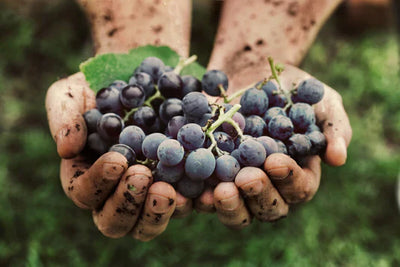
- Montepulciano d'Abruzzo DOC: the emblematic grape. Black grape, intense ruby color, rich in anthocyanins and polyphenols. Notes of ripe red fruit, spices, leather. It is the grape at the heart of Mo'Stò's Acqua Attiva di Vino;
- Trebbiano d'Abruzzo DOC: the most traditional white. Fresh, citrusy, mineralized by the clay hills;
- Cerasuolo d'Abruzzo DOC: rosé obtained from Montepulciano with short maceration. Cherry color, vibrant, perfect traditional rosé;
- Pecorino: an indigenous white grape experiencing a full resurgence. Mineral notes, marked savoriness;
- Passerina: another indigenous white variety, fresh and light.
Why Montepulciano d'Abruzzo is special for cosmetics
Montepulciano d'Abruzzo has a particularly high concentration of anthocyanins (the red-blue pigments in the skin) and polyphenols. This makes it not only a structured and long-lived wine, but also an excellent source of plant-based antioxidants for cosmetic use.
When Montepulciano skin is processed to extract its active ingredients, the resulting extract is rich in:
- Anthocyanins (anti-inflammatory and photoprotective action);
- Resveratrol (anti-aging, sirtuin activator);
- Polyphenols (antioxidants);
- Flavonoids (strengthen capillaries).
This is exactly the mix that fuels the Active Wine Water, the complex at the heart of Mo'Stò formulations. To learn more about the chemistry, read From the vineyard to the lips: wine in modern cosmetics.
Did you know? Abruzzo is one of the few Italian regions where you can go from the sea to the mountains in less than an hour. Hillside vineyards that overlook the Adriatic Sea to the east and Gran Sasso to the west have a double "soul": the salinity of the sea and the freshness of the mountains. A unique terroir reflected in the character of the wine—and in the value of the recovered waste.

Mo'Stò: an Abruzzese mother-daughter story
Behind the Mo'Stò brand are Marina and Lisa Panico: an Abruzzese mother and daughter who decided to transform their region's winemaking tradition into a contemporary cosmetic proposal.
The intuition arose from observing the winemaking cycle: every year, Abruzzese wineries produce thousands of tons of pomace, grape seeds, and skins—waste that, until then, ended up in compost or animal feed. Marina and Lisa looked at that waste with a question: what if it contained something precious?
From that question, Mo'Stò was born. The name itself is a small manifesto: "mosto" (must) is the essence of wine, the unfermented juice, rich in everything. But "mo' stò" is also an expression in the Abruzzese dialect, meaning "now I am here, I am taking my space." A dual identity: ingredient + declaration of presence.

The circular model
Mo'Stò collaborates with local wineries to recover Montepulciano d'Abruzzo grape seeds and skins. Raw materials that are carefully processed to extract oils and extracts for cosmetic formulas. A model that reduces waste, economically supports local wine producers, and maintains a short supply chain. To explore the sustainable dimension, read Sustainable cosmetics: from grape waste to skincare.
Mo'Stò products: Abruzzo in cosmetics
Each product in the line carries the territory with it:
Tradition and innovation: the Abruzzese balance
One of the characteristics that make Abruzzo special is its ability to hold tradition and innovation together. The region's wineries, for example, have managed to modernize winemaking techniques while maintaining ties to indigenous grape varieties and their territories of origin. The same applies to cosmetics: Mo'Stò does not deny tradition—it transforms it.
The Montepulciano extract comes from the same grapes that have been cultivated on the Abruzzese hills for centuries. Grape seed oil was already used in cooking and for small remedies. The novelty lies in the method: modern extraction techniques, dermatologically tested formulations, contemporary packaging, digital communication. But the essence remains the same: the Abruzzese raw material.
Mo'Stò in local and national press
The story of Marina and Lisa Panico, and the brand they built, has been covered by numerous publications. Il Pescara reported how "In Penne, a beauty brand transforms Abruzzese wine into a skincare ritual". Il Centro reported how "mother and daughter invent a cosmetic based on Montepulciano".
Recognitions that confirm the strength of a proposal that starts from the territory and, through cosmetics, brings it to the world.
Abruzzo as a "brand"
Many brands try to build an identity from scratch: storyboards, concepts, palettes. Mo'Stò did the opposite: it found its identity in the territory. Abruzzo was the brand even before Mo'Stò existed—Mo'Stò is merely its cosmetic ambassador.
This means authenticity: every product is the cosmetic translation of something that truly exists, not an invented story. It also means differentiation: no other brand can tell the story of Abruzzo like Mo'Stò, because no other brand was born there, from those vineyards, from those families.
Authentic beauty = territorial beauty
In a world where cosmetics often speak a global and undifferentiated language, authentic beauty comes through specificity. Mo'Stò is demonstrating that quality cosmetics can be made without compromising on standardization: one can speak the English of global marketing and, at the same time, claim Abruzzese origin.
It's the same logic that runs through high-quality Italian cuisine: not generic "Italian cuisine," but "Abruzzese cuisine," "Tuscan cuisine," "Sicilian cuisine." Precise identities, specific ingredients, rooted stories. Mo'Stò applies the same philosophy to skincare.
Frequently Asked Questions
What makes Abruzzo special for cosmetics?
The very high percentage of protected territory, the quality of agricultural raw materials (Montepulciano grapes, EVO oil, medicinal herbs), the winemaking tradition, and the presence of small producers who maintain short supply chains and quality.
Does Mo'Stò only use Montepulciano d'Abruzzo grapes?
Yes, the extract and grape seed oil of the Acqua Attiva di Vino complex are derived from Montepulciano d'Abruzzo grown in the region, recovered from the winemaking waste of local wineries.
What is the Abruzzese dialect "mo' stò"?
It literally means "now I am / now I am here." It's an expression that evokes presence, rootedness, a declaration of existence in one's space. The Mo'Stò brand plays on this double meaning: ingredient (the must of the wine) + declaration of presence.
Can I visit Mo'Stò's partner wineries?
The supplier wineries are independent wine companies in the Pescara and Chieti areas. Many of them offer tours and tastings. For specific information, you can contact Mo'Stò directly.
Do Mo'Stò formulas only contain Abruzzese ingredients?
The distinctive ingredients (Montepulciano extract, grape seed oil) are of Abruzzese origin. The complete formulas also include other active and functional ingredients (moisturizers, preservatives, emulsifiers) of cosmetic quality, chosen for efficacy and tolerability.
Conclusion
Abruzzo is a land that, in its discreet way, holds an extraordinary heritage. Vineyards, mountains, parks, stone villages: a geography of natural beauty that today also becomes cosmetic geography thanks to brands like Mo'Stò.
Every application of a Mo'Stò product is a small journey through this land: into the Montepulciano vineyards, into the wineries of Penne and its surroundings, into the stories of mothers and daughters who transform tradition into innovation. Continue to explore with From the vineyard to the lips or sustainable cosmetics.